Editor’s Introduction
Every August, we celebrate the moment India became independent.
But history suggests something deeper.
Author’s Note
This article is a personal reflection on India’s journey from political independence to digital capability. The views expressed are my own and are intended to explore the relationship between nation-building, technology, public infrastructure, and the responsibilities of the AI era.
References to public digital platforms such as Aadhaar, UPI, DigiLocker, FASTag, and CoWIN are used as examples of capability-building at scale. The article is not a policy analysis, political commentary, or endorsement of any institution. It is an invitation to reflect on how capabilities are built, sustained, and strengthened across generations.
Independence is rarely secured in a day.
It is built through capabilities that take decades to create and generations to sustain.
There is a photograph most Indians have seen, even if they weren’t alive to witness it: a flag rising over the Red Fort as midnight becomes morning.
It is one of the most reproduced images in the country’s visual memory, and it captures, with total accuracy, a single instant.
What it cannot capture is everything that instant required to mean something.
1947 gave India the right to govern itself.
It did not give India the roads to govern, the schools to educate the governed, the courts to adjudicate disputes among them, or the institutions to convert a subcontinent of extraordinary diversity into a functioning republic.
That took decades.
It is still taking decades.
Independence, it turns out, is not the moment a nation is handed the keys. It is everything that happens afterward to make the keys worth having.
This distinction — between the granting of independence and the building of it — is easy to state and hard to feel, because ceremonies are vivid and capability-building is slow.
A flag-raising happens in a morning.
An institution takes a generation.
We remember the morning.
We rarely notice the generation, because nothing about it looks like a single decisive event. It looks like thousands of unremarkable decisions, compounding.
The Quiet Decades
Consider what had to happen between 1947 and any meaningful sense of an Indian citizen exercising self-determination in daily life.
Universal adult suffrage had to be organized in a country where the majority of voters had never cast a ballot and much of the electorate could not read the ballot paper.
A currency, a civil service, and a federal structure had to be built for a territory larger than most continents’ worth of separate nations, each with its own language and history.
Steel plants, dams, and agricultural research had to close the distance between a population and the food required to feed it.
None of this made headlines the way independence itself did, because none of it was an event.
It was a capability under construction — visible only in retrospect, and only in aggregate.
A single dam commissioned in 1960 did not feel like sovereignty.
A few hundred of them, alongside a Green Revolution, a literacy campaign, and a banking system extended into villages that had never seen a bank branch, eventually did.
Sovereignty, it turns out, is rarely felt in the moment it is built.
It is felt only once enough of it has accumulated to become invisible.
This is worth sitting with, because the same pattern is now repeating in a domain that would have been unimaginable to the generation that built those dams:
the digital one.
A Second Infrastructure
Over the past decade, India has built something that rarely gets described with the gravity it deserves — not because it lacks importance, but because it doesn’t look like infrastructure.
It has no concrete.
No steel.
No ribbon to cut in front of cameras.
It is a layer of shared digital rails, built by different agencies for different purposes — identity, payments, documents, mobility, public health — that together now function as one thing:
a way for a citizen to be recognized, trusted, and served by systems that have never met them in person.
Aadhaar, UPI, DigiLocker, FASTag, and CoWIN are, individually, products.
Collectively, they are closer to what economists and technologists have started calling public digital infrastructure — shared, foundational systems that a private company, a government office, or an ordinary citizen can build on top of, the way earlier generations built on top of roads and electricity.
None of them earned their significance on launch day.
Each was, for a time, simply an idea a ministry had funded and a small number of early users had tried.
What made them consequential was not the announcement but the slow, cumulative process of becoming load-bearing — the moment a fruit vendor, a migrant worker, a retired teacher, and a college student each independently decided to trust the same system with something real.
That moment is worth naming precisely, because it is the hinge on which this entire idea turns.
A system becomes a capability at the exact moment people stop thinking about it as a system and start relying on it the way they rely on electricity — noticing it only when it’s absent.
A currency is not sovereign because a central bank prints it.
It is sovereign because people accept it in exchange for their labor.
A digital identity is not a capability because it exists in a database.
It is a capability the day a citizen with no other paperwork can use it to open a bank account.
Launch is permission. Adoption, sustained across millions of ordinary, unrecorded decisions to trust it again tomorrow, is proof.
The Harder Half of the Work
What is easy to overlook, amid all of this, is that building a capability and sustaining one are not the same skill.
The second is by far the less glamorous of the two.
A dam can be commissioned once.
It has to be maintained forever.
A digital identity system can be launched once.
It has to remain worthy of trust every single day after, through every new vulnerability, every policy change, every edge case that its designers never imagined.
Trust of this kind is accumulated in decades and can be spent in an afternoon.
That is precisely why it is not a feature to be shipped but a discipline to be practiced indefinitely.
Every generation, in this sense, inherits infrastructure it did not build and did not fully choose.
Its real inheritance is not the system itself but the obligation to keep it worth inheriting.
The true measure of any capability, digital or institutional, is not how impressive it looked when it was new, but whether the generation that received it chose to strengthen it rather than simply spend it down.
It is this obligation — not the technology itself — that connects the India of 1947 to the India now approaching a new technological threshold.
The dam-builders and census-takers of the mid-twentieth century were not laying the groundwork for UPI specifically.
They had no way to imagine it.
What they were building was a habit:
the expectation that each generation would extend what it inherited rather than merely use it up.
Digital public infrastructure is that habit’s most recent expression.
Artificial intelligence will be its next test.
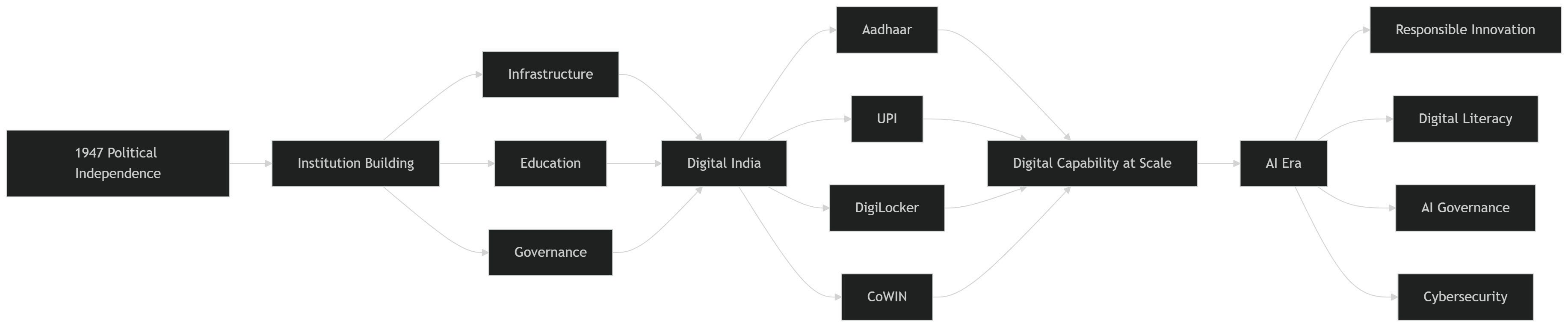
Capability Evolution: from institution-building after independence to digital public infrastructure and the emerging AI era.
What the Next Chapter Asks For
If public digital infrastructure was the last decade’s capability-building project, the next one is already visible on the horizon.
And it will not forgive complacency about what was already achieved.
Artificial intelligence built on top of identity, payments, and other large-scale digital infrastructure carries a different order of consequence than any one of those systems carried alone.
Readiness for that shift is not primarily a question of model access or computing capacity.
It is a question of whether the country’s data governance, consent frameworks, cybersecurity practices, and grievance-redressal mechanisms are as mature as the infrastructure they will sit on top of.
Digital literacy has to extend beyond the ability to scan a QR code toward the ability to reason about what a system built on one’s own data is doing.
Cybersecurity has to keep pace with the fact that infrastructure this widely relied upon is now, by definition, high-value infrastructure for anyone who wishes it harm.
And inclusion has to remain a design constraint, not an afterthought.
Because a capability that works brilliantly for the digitally fluent and poorly for everyone else is not, in the fullest sense, a national capability at all.
None of this is a criticism of what has been built.
It is simply what capability-building has always demanded:
today’s achievement must be treated as tomorrow’s foundation rather than tomorrow’s finish line.
The systems that got India this far were themselves built by people who inherited an earlier, incomplete independence and refused to treat it as complete.
The next generation inherits the same responsibility.
From Digital Infrastructure to AI Capability
There is a temptation to treat AI as a completely new chapter — something that arrived independently of everything that came before it.
I don’t think that’s accurate.
AI capability depends on layers of capability that precede the model itself:
- digital identity;
- reliable digital transactions;
- accessible public services;
- data infrastructure;
- cybersecurity;
- institutional trust;
- digital literacy;
- governance mechanisms;
- and the ability to deploy technology at population scale.
The model may be the most visible component.
It is not necessarily the most important one.
A powerful model sitting on weak governance is not a national capability.
A sophisticated AI system that excludes large sections of the population is not a national capability.
An AI service that cannot be trusted with citizen data is not a national capability.
The hard work is therefore not simply building increasingly capable models.
It is building the institutional and infrastructural environment in which those models can be used responsibly and at scale.
That is a much harder problem.
And it is much closer to the kind of nation-building that began in 1947.
Returning to the Thesis
It is tempting, every August, to let the story end at the flag.
The story is more interesting, and more useful, if it doesn’t.
What 1947 actually started was not a condition but a project — one carried forward by dam engineers and census-takers, by the architects of a banking system that reached villages, by the teams who built an identity and payments layer relied upon by a scale of citizens no single generation could have imagined serving, and, soon enough, by whoever builds responsibly on top of what those systems have made possible.
Independence is not an event.
It is a capability.
And capabilities are never finished.
They are built, maintained, tested, adapted, and rebuilt by successive generations.
The real question for the next generation is therefore not whether India has become technologically capable.
It is whether we can build systems capable of being trusted, governed, secured, and sustained at the scale to which we aspire.
Independence is a capability — built once, and then rebuilt, generation after generation, by whoever is willing to treat the work as unfinished.
References
Government & Public Infrastructure
- National Payments Corporation of India (NPCI)
- Aadhaar — Unique Identification Authority of India (UIDAI)
- DigiLocker
- FASTag — NETC
- CoWIN
Additional Reading
- India Stack
- Digital Public Infrastructure initiatives — Digital India
- RBI Digital Payments Reports
- Ministry of Electronics and Information Technology (MeitY)
Related Articles
When Data Becomes the Bottleneck
An investigation into why apparent data-platform and SLT failures can actually emerge from contention, latency, capacity, and the interactions between different layers of an analytics architecture.
The Post-Acquisition Assumption Gap
How inherited assumptions around CDC, SCD, provenance, and governance can survive long after systems have been technically integrated.
About the Author
Aniruddha Banerjee is a Data Platform Architect, BI and Analytics leader, and technology writer with nearly two decades of experience delivering enterprise data and analytics solutions across global organizations.
His writing explores the intersection of data, AI, digital transformation, architecture, and technology leadership.
Through Aniruddha Writes, he shares practical insights, long-form essays, and reflections on how technology shapes organizations, industries, and society.